Honey and Mustard Glazed Gammon
Simmered until tender, then roasted with a sticky honey-mustard glaze: a Sunday centrepiece that also gives you ham for the week.
AI assistance: the introduction, ingredient list, method, tips and FAQ on this page were drafted with an AI writing tool, working from long-established traditional methods. Named editor who reviewed it: owner to supply How we work
- Prep
- 20 min
- Cook
- 1 hr 50 min
- Total
- 2 hr 25 min
- Makes
- 8 servings
- Difficulty
- Easy
- Course
- Main
- Cuisine
- English

A glazed gammon looks spectacular and is easier than a roast: it is simmered first, so it stays juicy, then given a short blast in a hot oven to caramelise the glaze.
It is a classic for Christmas and Boxing Day, but just as good on any Sunday, with leftovers for sandwiches.
Ingredients
Gammon
- 2 kg unsmoked gammon joint, boneless
- 1 onion, halved
- 2 bay leaves
- 1 tsp black peppercorns
- about 20 whole cloves
Glaze
- 3 tbsp runny honey
- 2 tbsp wholegrain mustard
- 2 tbsp soft brown sugar
Equipment
Shop links are affiliate links (disclosure).
Method
- 1
Put the gammon in a large pan with the onion, bay and peppercorns, cover with cold water and bring slowly to the boil. Skim, then simmer gently for 20 minutes per 500 g (about 1 hour 20 minutes for 2 kg).
- 2
Heat the oven to 200°C / 180°C fan / gas 6. Lift the gammon out and let it cool for 10 minutes. Cut off the skin, leaving a thin layer of fat, and score the fat in a diamond pattern. Press a clove into each diamond.
- 3
Mix the honey, mustard and sugar, then brush over the fat.
- 4
Roast in a foil-lined tin for 20–30 minutes, basting with the glaze once or twice, until sticky and golden. Rest for 15 minutes before carving.
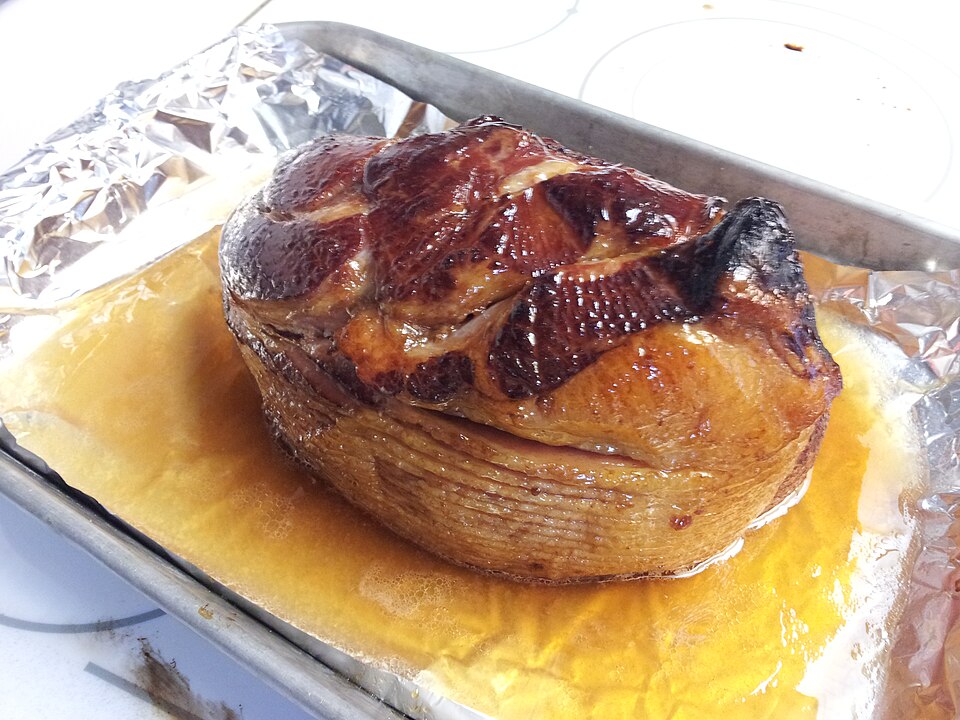
Photo: Daniel Hanson from Phoenix AZ, USA via Wikimedia Commons, CC BY 2.0, cropped

Tips
Serve hot with roast potatoes and parsley sauce, or cold with pickles. A meat thermometer confirms it is cooked through, and a sharp carving set makes thin slices easy.
If it goes wrong
| Problem | Likely cause | Fix |
|---|---|---|
| Glaze burns | Oven too hot or left too long | Check after 15 minutes and cover the edges with foil |
| Gammon too salty | Strongly cured joint | Soak it overnight in cold water if the label suggests it |
Frequently asked questions
Do I need to soak gammon before cooking?
Most modern gammon joints are mildly cured and do not need soaking. Check the label; soak very salty joints in cold water overnight.
How do I know gammon is cooked?
The Food Standards Agency advises the middle of the joint reaching 70°C for 2 minutes. Use a thermometer in the thickest part.
How long does cooked ham keep?
Cool it quickly, wrap it and keep it in the fridge. Use leftovers within a couple of days, or freeze slices for later.
Sources
- Cooking your food, Food Standards Agency (GOV.UK), 18 December 2017. Checked 5 October 2026.
Guides for this recipe
Some of these guides contain shop links, which are affiliate links (disclosure).

Kitchen design
Range Cookers: Are They Right for Your Kitchen?

Buying guide
Roasting Tins: Choosing the Right Size and Material

Kitchen design
Christmas Dinner: How to Plan Your Oven and Hob Space

Buying guide
Chef's Knives: How to Choose One

Kitchen design
Knife Storage: Blocks, Magnetic Strips and Drawer Inserts

Kitchen design
Copper Pans in the Kitchen: Cooking, Display and Care

Buying guide
Saucepans: Stainless, Non-Stick or Copper?
More English Food recipes

Recipe · 3 hr 30 min
Beef and Ale Pie
Tender beef braised in dark ale under a golden puff pastry lid: a proper pub classic at home.

Recipe · 2 hr 45 min
Cornish Pasty
Beef skirt, potato, swede and onion, baked raw inside a crimped pastry case: the traditional way.

Recipe · 3 hr 20 min
Homemade Mincemeat
Make it this week and it will be mellow and ready for your first mince pies: spiced fruit, apple, suet and a splash of brandy.
Card photos: A traditional black cast-iron kitchen range, Wehha via Wikimedia Commons, CC BY-SA 3.0, cropped; Potatoes with rosemary in a roasting tin, ready for the oven, Chris Olszewski via Wikimedia Commons, CC BY-SA 4.0, cropped; A golden roast turkey, Photo by M. Rehemtulla via Wikimedia Commons, CC BY 2.0, cropped; A chef's knife with a wooden handle, Frank Schulenburg via Wikimedia Commons, CC BY-SA 4.0, cropped; Kitchen knives held on a wall-mounted magnetic strip, Phil! Gold from Pikesville, MD, USA via Wikimedia Commons, CC BY-SA 2.0, cropped; Copper pans and a kettle on an old kitchen range, Silar via Wikimedia Commons, CC BY-SA 4.0, cropped; A small stainless steel saucepan with a lid, Cooks & Kitchens from Darlington, UK via Wikimedia Commons, CC BY 2.0, cropped; A steak and ale pie served with gravy, broccoli and carrot, Andy Li via Wikimedia Commons, CC0; A golden, crimped Cornish pasty on a plate, David Johnson [1] via Wikimedia Commons, CC BY-SA 3.0, cropped; Homemade mincemeat being stirred with a wooden spoon, Stuart Caie via Wikimedia Commons, CC BY 2.0, cropped. All credits: image credits.